


 Menu
Menu
News

Wednesday the 29th of January 2025
L’Orchestre du Nouveau Monde: Music in Service of a Better World
Étienne Jarrier, conductor and co-founder of l’Orchestre du Nouveau Monde, talks about this project blending classical music with social and climate activism. He shares his journey, the composition of the orchestra, and the impact of his art freed from conventions.
Étienne, you are the co-founder and conductor of the Orchestre du Nouveau Monde, the first French orchestra committed to social and climate justice. What is your background, and how did the idea of forming this philharmonic ensemble come to you? How is the orchestra composed?
Étienne Jarrier: I wasn’t destined to become a conductor. My parents weren’t musicians, and I didn’t follow the traditional path for it. After ten years of playing the clarinet at the conservatory, I was eager to break free from that conventional path. I wanted to create projects, and one of them took the shape of a philharmonic ensemble founded around a group of friends who enjoy coming together to make spontaneous music and, above all, share the same core values. It naturally became a militant orchestra, deeply outside the box.
Our ensemble breaks the straight lines of sheet music. Today, classical music is confined within a framework. Each concert feels like a museum: the rigid setting of a piece, with its fixed light and small label. We play with these codes, surpass them by blending frameworks and works, redefining the structure of a symphony, the entrances, and the positioning of musicians. In short, it’s about breaking free from protocol so that everyone can enjoy classical music without needing any educational background. It’s no longer about coming to listen to a particular piece or composer, but about coming to listen to l’Orchestre du Nouveau Monde.
In fact, just like its audience, the musicians of l’ONM are diverse, coming from all backgrounds and musical styles. There are professionals who will become soloists or great professors, but also passionate individuals who refuse to make a career out of their instrument. L’Orchestre du Nouveau Monde is this symbiosis, this union of diverse individuals around a shared ideal.
You say you want to create a link between music and politics through your performances: what are the points of connection between these two worlds, and what is the goal of this blend?
Politics is, first and foremost, a matter of emotions, not technicality or pragmatism. It’s the ideas that convince us, not the details. Music has the same concern: it is built around effectiveness and clarity but aims for a deep connection to the personal. The symphonic orchestra creates this extremely pure link because it is, at its core, disconnected from any form of discourse. And that’s precisely what allows us to attach our societal, current, and mobilizing discourse to it.
Devoid of language, music is universal; it’s a raw sensation. But currently, classical music is reduced to performers who appropriate works. However, their interpretation is always based on the style of playing. We are convinced that classical music is a raw material to be molded. We want to make it our own interpretation, centered around issues that directly concern us. We aim to reconnect classical music to the world of today.
Beyond your concerts, you also carry out various awareness and activism actions with l’Orchestre. Why did you choose classical music as a means of action, and what about its effectiveness?
Music is a great means of action because it carries, in addition to its cultural and symbolic baggage, subtler messages than mere words. If, during the legislative elections, we had shown up in front of the National Rally headquarters with just slogans and banners, we would never have achieved the same nuance in our message. By playing “Maréchal, les voilà!” by the resistance fighter Julien Clément, we were able to bring in sensitivity, humor, perspective, and a questioning of the repetition of history. Only art can do that.
We position ourselves as artists, not just activists. We don’t produce finished discourse; we prefer to ask questions and encourage reflection. We are convinced that this is far more effective than delivering answers. We trust our audience, the people who listen to us. We give them keys, not manuals.
With your original creation “Fracas,” l’Orchestre will perform on Saturday, March 15, during the closing session of l’Université de la terre, an event centered around the theme “Nature = Future.” How does your project resonate with this event, and what message do you want to convey through this performance at UNESCO?
The theme "Nature = Future" raises the question of being able to imagine tomorrow while living today. Art makes a future connected to nature plausible. Our creation “Fracas” illustrates this journey from the present to the future. It’s the spectacle of a dying world, corrupted, suddenly transformed by a force into a calm, peaceful sea. From chaos to cosmos. We are thrilled to close these two days of debates and intense reflection with an invitation to daydream, to hope. A blank page to be written together.
The Orchestre du Nouveau Monde is a project supported by the fonds de dotation de l'Université de la terre, which supports various projects aimed at improving our understanding of ecological transition issues and encouraging the shift to action.
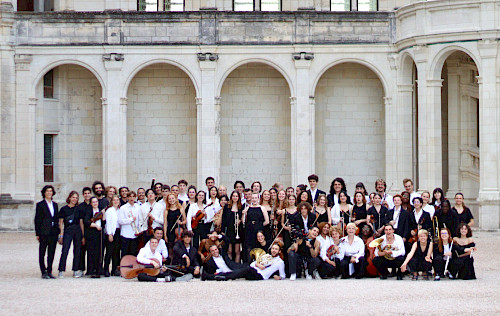
Meet the Orchestre du Nouveau Monde at the Université de la terre on March 15, 2025
>> Register HERE <<